


You might be patting your dog on the belly or along the ribs when, suddenly, a back leg starts pumping like it has a mind of its own. People often read it as a sign that the dog is “loving it”, and sometimes the timing makes that feel like the obvious answer.
But that rhythmic kick is usually something a bit simpler and more mechanical: a built-in skin reflex that helps the body respond quickly to a light irritation. It is interesting partly because it looks so expressive, and partly because it can occasionally draw your attention to a dog who is a bit itchier than normal.
Understanding the scratch reflex does not mean you need to stop belly rubs. It just helps you read the moment more accurately, and notice when “cute” might be worth a closer look.
The scratch reflex, in plain terms

The canine scratch reflex is an involuntary movement triggered by stimulation of the skin. When you scratch, rub, or even lightly tap certain areas, sensory nerves in the skin send signals into the spinal cord, which then activates a patterned kicking motion in the hind leg.1, 2
What matters here is that this loop does not require “decision-making” in the way we normally think about it. The leg can start moving even if the dog is relaxed, distracted, or not particularly focused on the touch. That is why it can happen suddenly, and why it can continue briefly even after you stop.
It also explains why the same dog can react strongly one day and barely at all the next. Reflexes are influenced by the intensity of touch, the exact spot you hit, and what the skin and nerves are experiencing at the time.
Where it tends to happen, and why those spots

Most dogs show this reflex when you touch the so-called “saddle” region, which commonly includes the belly, flanks, sides, and lower back.1 These areas have plenty of sensory input, and they are also places a dog cannot easily reach with its mouth.
There is a bit of individual variation. Some dogs have a very reliable “sweet spot”, while others only kick with firmer scratching. Coat type, skin sensitivity, current itch levels, and simple body differences all play a part.
If you are trying to interpret what your dog is feeling, it helps to treat the kick as information about nerves, not as a guaranteed sign of enjoyment. Many dogs do enjoy belly rubs, but the reflex itself is not proof.
What it is for, biologically
In evolutionary terms, a reflexive scratch action is often described as a protective response that helps dislodge irritants such as biting insects. The body does not need to identify the problem first. It just reacts fast, using an efficient spinal pathway to produce a repetitive kicking motion.2, 3
This is one reason the reflex can look so purposeful. The movement pattern is designed to be quick and repetitive, which is useful when the “irritant” is small, mobile, and hard to locate precisely.
It is also why dogs who are already itchy can appear to have a stronger or more easily triggered reflex. If the skin is irritated, the sensory system may be more reactive than usual.1, 4
When the reflex is normal, and when it might suggest a problem
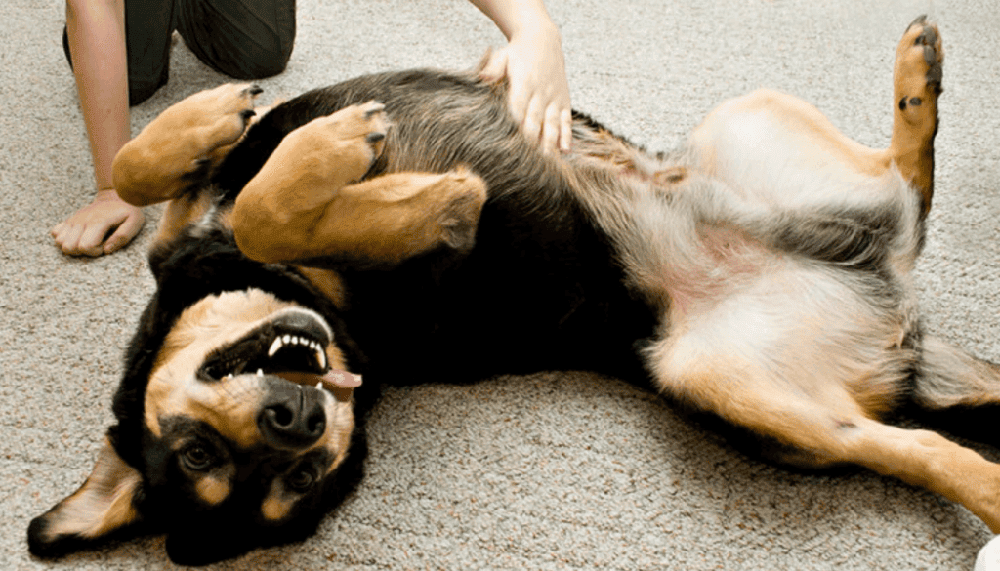
For most dogs, a bit of leg kicking during pats is completely normal. On its own, it is not a symptom that needs treating.
It is worth paying closer attention, though, if the kick comes with other signs that the skin is uncomfortable, or if your dog seems less tolerant of touch than usual. Itching (pruritus) is a sign rather than a diagnosis, and common causes include parasites (fleas or mites), infections, and allergies.4
Consider booking a vet visit if you notice any of the following alongside the reflex:
- Frequent scratching, licking, or chewing, especially paws, belly, or tail base4, 5
- Redness, scabs, hair loss, or a change in coat quality4, 5
- A strong skin or ear odour, or recurring ear irritation4, 6
- Sudden sensitivity to touch in areas that were previously fine
Fleas deserve special mention. Even when you do not see live fleas, flea allergy dermatitis can still be a driver of intense itch in some dogs, and the itch is often noticeable around the lower back and tail base.7, 8
Petting in a way that keeps your dog comfortable

A good rule is to keep your touch soft and pause often. Many dogs prefer calm strokes on the chest, shoulder, or along the side rather than fast, repetitive patting.
Watch the whole dog, not just the leg. A reflex kick can happen while a dog is comfortable, but it can also happen when the skin is slightly irritated. Look for easy, loose posture and a dog who chooses to stay close. If the dog turns the head away repeatedly, licks lips, shows “whale eye” (whites of the eyes visible), freezes, or shifts weight away, those can be signs of stress or uncertainty, and it is kind to stop and give space.9
If you are unsure, try a brief “pat then pause” approach. Touch for a couple of seconds, then stop and see what your dog does next. A dog who leans back in or nudges for more is offering clearer feedback than a reflexive leg kick.
Practical takeaways (without overthinking it)
The scratch reflex is a neat reminder that dogs are full of automatic, efficient little systems. It is not a party trick, and it is not a secret message either.
- Leg kicking is usually normal and simply means you triggered a skin reflex.1, 2
- If your dog seems generally itchier, check parasite prevention and talk to your vet about causes such as fleas, allergies, or infection.4, 7
- Let comfort, body language, and choice guide how and where you pat, rather than relying on the reflex as your main signal.9
References
- Wikipedia: Scratch reflex
- Hemopet: Is that the spot? Why does my dog kick when I scratch him? (Scratch reflex)
- Hill’s Pet: Dog Scratch Reflex and Leg Kicking
- Merck Veterinary Manual (Dog Owners): Itching (Pruritus) in Dogs
- Merck Veterinary Manual (Dog Owners): Dermatitis and Dermatologic Problems in Dogs
- Vets Love Pets: Skin Conditions in Dogs, Vet-Recommended Care and Treatment
- RSPCA Australia Knowledgebase: How do I stop my companion animal from getting fleas?
- Vet-n-Pet Direct Help: Flea or Allergy?
- Alliance of Therapy Dogs: Canine Body Language (stress signals)