


You might come across an Irish Red and White Setter at a park or on a country walk and do a double take. The coat looks like a classic setter’s, but the colour is bold and clean, and the dog often moves like it has a job to do, even when it is “just” out with the family.
People sometimes assume they are simply a rarer colour of Irish Setter, or that a gundog breed will automatically be difficult in a home. In practice, what shapes life with this breed is less about labels, and more about daily outlets for energy, a steady approach to training, and an appreciation for a dog that still carries strong field instincts.
When those pieces come together, the Irish Red and White Setter can be a deeply rewarding companion. When they do not, you tend to see the same patterns, restlessness, over enthusiasm at the lead, and a youngster who struggles to settle.
- Breed category: Gundog (pointing dog)
- Country of origin: Ireland
- Typical height: About 57 to 66 cm at the withers (varies by standard and sex)1, 2
- Typical weight: Commonly around 16 to 27 kg, many adults sit higher or lower depending on build and lines3
- Life expectancy: Often cited around 11 to 15 years, with variation across sources and individuals3
- Coat: White with solid red patches, with feathering on ears, chest, legs and tail2
- Energy needs: High, generally suits people who genuinely enjoy getting out every day
Early development and work in the field

The Irish Red and White Setter is a pointing dog developed for locating game birds, covering ground in a purposeful pattern, then “setting” on scent so a handler can move in.2 That history still shows up in modern dogs as stamina, a strong nose, and an instinct to range out and investigate.
The breed’s story also includes a period of serious decline, followed by organised efforts to rebuild numbers and type. It is now recognised internationally, with the Fédération Cynologique Internationale (FCI) accepting the breed on a definitive basis in 1989.1
If you are looking at puppies, it is worth asking whether the breeder prioritises working ability, show, or a middle ground. None of those paths are inherently “better”, but they can influence how much daily exercise and training structure a young dog needs to cope well in a typical home.
Appearance and what makes the breed distinctive
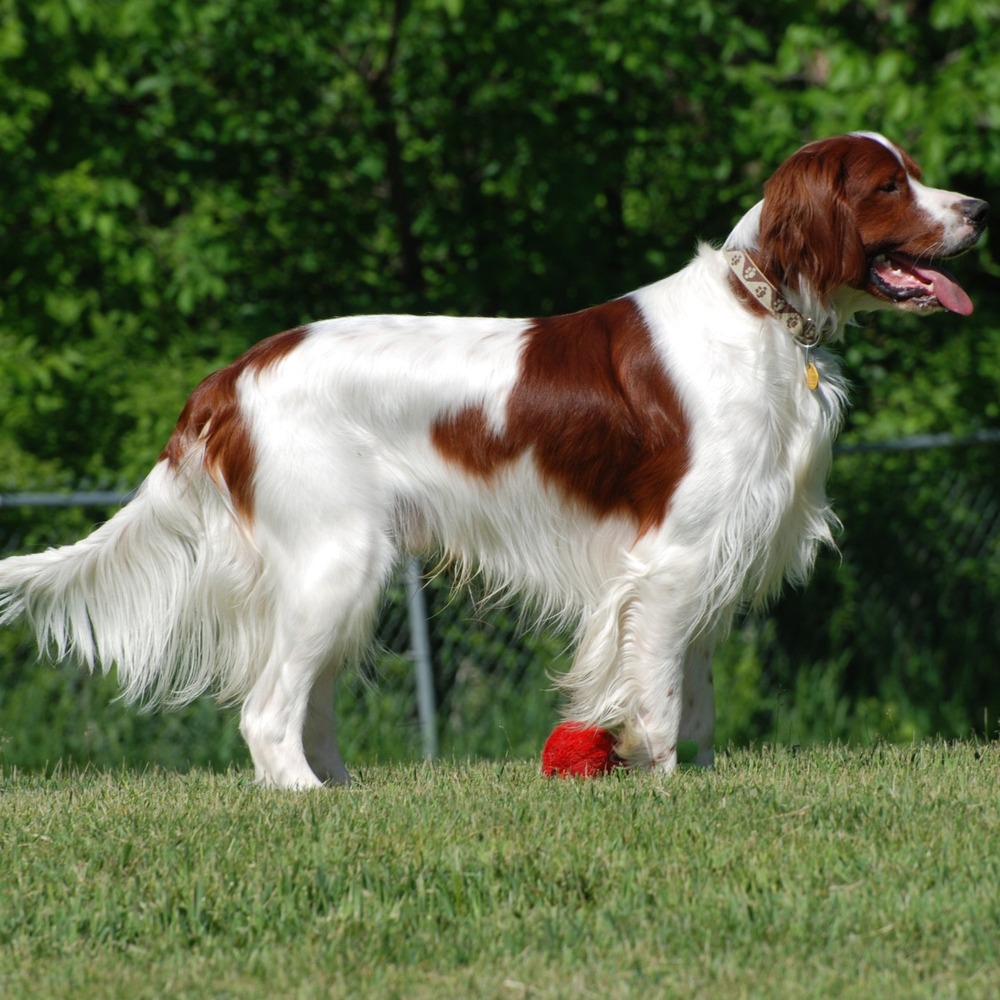
The first thing most people notice is the colour. The standard describes a red and white dog, with the coat on the body generally straight and flat, and softer feathering on the ears, chest, legs and tail.2 In the field, that contrast is practical as well as beautiful, it makes the dog easier to see at distance.
In outline, the Irish Red and White Setter is athletic and balanced. The UK Kennel Club describes the breed as strong and powerful, “athletic rather than racy”.4 In everyday terms, you are looking at a dog built to move for hours, not a dog designed for short bursts of effort.
Those drop ears and feathering are part of the setter look, but they also create a routine reality for owners. You will be checking ears after wet runs, brushing out burrs, and keeping an eye on tangles around the feathering.
Temperament and suitability for family life

Well bred Irish Red and White Setters are often described as biddable, intelligent, and good natured.4 Many are social dogs that enjoy being included, and they tend to do best when their day has some shape, movement, training, and time near their people.
It helps to think in terms of arousal and recovery. These dogs can get excited quickly, especially adolescents, and they need practice coming back down again. That is less about “calming them” and more about teaching skills: waiting at doors, settling on a mat, walking on a loose lead, and switching between play and quiet.
If you have children, the match is usually strongest in households where adults are happy to manage boundaries and routines. A friendly, energetic dog can be wonderful with kids, but it still needs supervision, and children need coaching on how to give a dog space when it is eating, resting, or over stimulated.
With other pets, many individuals live happily with other dogs. With smaller animals, the hunting background matters. If you have cats, poultry, or pocket pets, plan on slow introductions and management, and do not assume a friendly dog will automatically be safe without training and careful set ups.3
Training and exercise that actually helps
Setters are smart, but they are also easily reinforced by the environment. A scent trail, a bird call, a moving object, all of these can “pay” the dog more than a treat if you have not built value in working with you. That is why early training pays off so well in this breed.
A useful approach is to build three things in parallel:
- Recall and check-ins, taught first in low distraction places, then gradually around bigger temptations.
- Loose lead skills that focus on rhythm and calm, rather than constant correction.
- Settle and switch-off behaviours (mat training, crate rest, calm chews) so the dog can recover after activity.
For exercise, most adults need a real daily outlet that goes beyond a quick loop around the block. Long walks, off lead running where legal and safe, hiking, scent games, retrieving, and structured dog sports can all suit the breed. The AKC notes the breed was developed primarily for the field, and it still tends to thrive when it has meaningful work or sport to do.5
If your setter is “naughty” in the house, it is often a sign the day has too little movement, too little training, or too much free access to the most exciting environments before the foundations are built.
Health considerations and sensible screening

No breed is free of health issues, and it is kinder to be realistic about this early. Hip dysplasia is a concern across many medium to large active breeds, and eye problems are also discussed in breed circles and standards.
There are also specific inherited conditions monitored by some breed organisations. In the UK, the Kennel Club has described DNA based controls around Canine Leucocyte Adhesion Deficiency (CLAD) and von Willebrand’s disease (vWD) in Irish Red and White Setters, alongside eye screening for conditions such as posterior polar cataract (PPC).6
If you are buying a puppy, ask for clear evidence of health testing relevant to the breed, not just a general statement that the parents are “healthy”. For owners, keep your dog lean, build fitness gradually, and book regular veterinary checks so small issues are picked up early.
Coat care, ears, and the everyday grooming rhythm
The coat is not high maintenance in the sense of constant clipping, but it does respond to routine. A couple of thorough brushes each week will usually prevent matting and reduce shedding around the house.
Pay attention to the feathering behind the ears, under the chest, and along the back of the legs, these spots catch burrs and knots. After wet outings, dry the ears and check for debris. Drop ears can be a comfortable design for a working dog, but they can also trap moisture, so ear checks are not optional for many individuals.
Nails, teeth, and skin checks fit naturally into the same routine. If you start this handling when the dog is young, most setters accept grooming as part of normal life rather than something to be endured.
Food and feeding, choosing something defensible
Active gundog types can look “fit” even when they are carrying extra weight, especially once feathering comes in. It is worth learning how to body condition score your dog and adjusting food with seasons and workload.
When choosing a diet, look for a complete and balanced food from a manufacturer that can answer basic due diligence questions about formulation, quality control, and nutritional expertise. The World Small Animal Veterinary Association (WSAVA) Global Nutrition Committee provides practical guidance owners can use when assessing pet food brands.7
For many deep chested, athletic breeds, it is also sensible to discuss bloat risk and feeding habits with your vet. The American Veterinary Medical Association summarises what is known about gastric dilatation volvulus (GDV) and common prevention conversations, including lifestyle and surgical options in some cases.8
A quiet note on rarity and recognition
Depending on where you live, you may not see many Irish Red and White Setters. In some places, that rarity is part of the appeal. It also means you may wait longer for a well bred puppy, and you may need to travel to meet breeders whose priorities align with yours.
Internationally, the breed’s formal recognition has a few milestones that are easy to mix up. The FCI accepted the breed on a definitive basis in 1989.1 In the United States, the AKC announced full recognition effective 1 January 2009.9 Those dates matter mainly because they reflect how the breed has been recorded and promoted across different kennel systems.
Final thoughts
The Irish Red and White Setter tends to suit people who like living with a dog that is present, busy, and ready to go. When their needs are met, they often settle into family life with a warm steadiness, and they can be wonderfully responsive partners for training, hiking, and dog sport.
If you are considering the breed, the best question is not whether they are “easy”, but whether you can offer the things they are built for: movement, training, and inclusion. That is where this breed usually shines.
References
- Fédération Cynologique Internationale (FCI): Irish Red and White Setter (No. 330)
- FCI Breed Standard (PDF): Irish Red and White Setter
- American Kennel Club (AKC): Irish Red and White Setter
- The Kennel Club (UK): Irish Red and White Setter breed standard
- Irish Red and White Setter Association of America (IRWSAA): Breed standard (AKC official standard)
- Wikipedia: Irish Red and White Setter (overview and cited sources)
- WSAVA Global Nutrition Guidelines
- American Veterinary Medical Association (AVMA): Gastric dilatation volvulus (bloat) in dogs
- AKC Press Release: Irish Red and White Setter gains full AKC recognition (effective 1 January 2009)